Necropolitics and Resistance in an Age of Surveillance and Exclusion
How Gestures of Humanity Challenge the Machinery of Death
Dr. Rachel Ainsworth
Research Director for SoDy
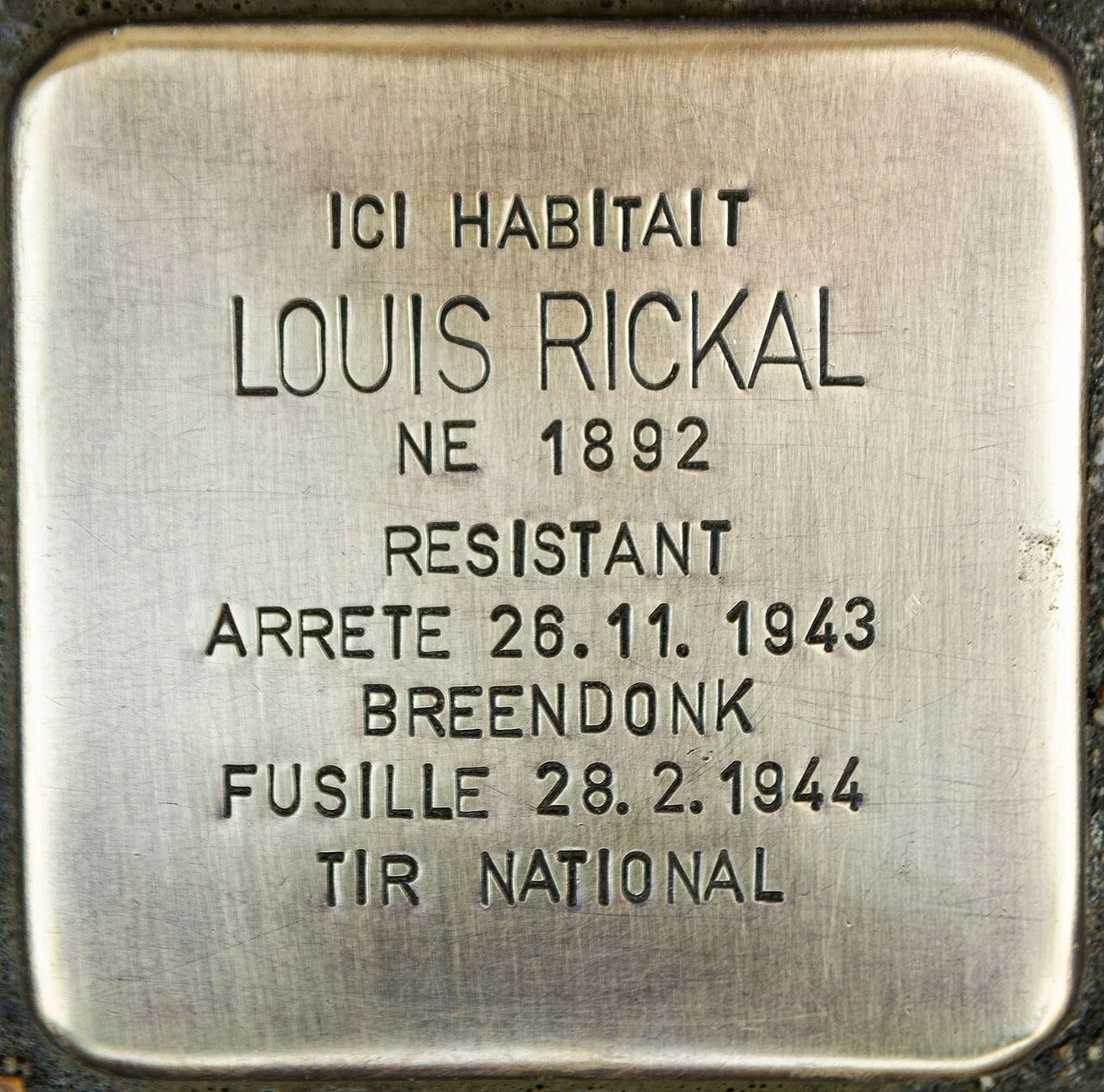
Bronze plaque dedicated to Louis Rickal, a resistance fighter who was captured and executed by the Nazi’s during World War II (source)
As I stroll through my Brussels neighbourhood, I frequently encounter an unassuming bronze plaque embedded in the pavement outside a narrow brick apartment. This plaque commemorates Louis Rickal, a former resident who joined the resistance during the Second World War. Rickal was arrested by the Nazis in 1943, sent to the Breendonk concentration camp, and ultimately executed a year later at the National Shooting Range in Schaerbeek, a location not far from where I reside. His involvement in the resistance was a courageous act against the horrors of fascism, seeking to protect his community at a time when the Gestapo targeted Jewish residents, minority groups, and ideological opponents, deporting many to camps such as Auschwitz, Ravensbrück, and Breendonk.
Eighty-two years on, I find myself reflecting on similar acts of resistance by Renee Good and Alex Pretti in Minneapolis. As witnesses to the inhumane ICE operations targeting immigrants for deportation, they sought to document and defend their community, a place they called home. Tragically, like Rickal, both Good and Pretti were murdered. These deaths represent a significant and grievous loss, inflicted by destructive forces. Although the specific circumstances differ, a pattern emerges: whether under a totalitarian regime or a self-proclaimed democracy, both political systems have actively dehumanised minority groups, upheld white supremacy, promoted militarism and the cult of masculinity, and vilified opposition. Recent remarks by Trump, likening Somali Americans to ‘garbage’, and Kristi Noem’s Department of Homeland Security slogan ‘One of ours, all of yours’—an echo of Nazi-era collective punishment associated with the Lidice massacre—demonstrate disturbing continuities of ideologies indorsing hatred and suffering.
All three cases painfully illustrate how mechanisms of biopower, as philosopher Judith Butler describes, distinguish between ‘grievable’ and ‘non-grievable’ lives. In other words, oppressive forces regularly promote ideas that certain lives are worth safeguarding and other lives are dispensable. The Trump administration has made it glaringly apparent that immigrants, people of colour, LGBTQ+ individuals, and political opponents are deemed less valuable. Following Good’s death, President Trump, Kristi Noem, and Vice President JD Vance labelled her a ‘left-wing agitator’, ‘domestic terrorist’, and accused her of ‘using her car as a weapon against federal law enforcement’, thereby justifying the lethal force used against her. Similar rhetoric surrounded Pretti, who was also called a ‘domestic terrorist’. Gregory Bovino, the former Border Control Commander, who is known for dressing in attire reminiscent of an SS officer, portrayed ICE agents as the true victims in Pretti’s murder, while Pretti himself was branded a criminal ‘suspect’. Such blatant misrepresentations, as Butler notes, reveal how “a legal regime that seeks to monopolize violence must call every threat or challenge to that regime a ‘violent’ one. Hence, it can rename its own violence as necessary or obligatory force, even as justifiable coercion, and because it works through the law, as the law, it is legal and hence justified p.133.” In effect, logic is inverted, and non-violent protests or the exercise of First Amendment rights is cast as aggressive, allowing an oppressive regime to defend its own acts of violence in the name of law and order.

A vigil held for Renee Good on January 9, 2026 at Paul Bunyan Park in Bemidji, Minnesota. Two days earlier, Good was killed by an ICE agent while observing ICE actions in her community. (source)
This modus operandi is characteristic of necropolitics or necropower, as theorised by Achille Mbembe and can help us make sense of this moment in time. The foundations of contemporary necropolitics are rooted in the legacies of slavery, colonialism, and racism. Necropower is not confined to totalitarian states such as the Nazi regime; it also persists in modern democracies, which deploy similar tactics under the guise of legality. Mbembe refers to this as the ‘nocturnal body’, denoting the concealed ways in which violence is sanctioned and legitimised through jurisprudence. Exemplifying the legal means used to promote this brutality, in January, a Minnesota Federal, Judge Kate Menendez, denied the state of Minnesota’s request to end the ICE operations in Minneapolis as she argued the state failed to show a violation of the 10th amendment (a check on federal authority and protection of state sovereignty). This facade of democratic legality further normalizes the processes of othering and reducing individuals to less than human status. This normalization of treating certain humans as the ‘other’ is nothing new to US history, especially for indigenous and African Americans and other marginalized communities. With Trump 2.0, the relentless assault on immigrants (regardless of documentation status), people of colour, and those who advocate and protest for the human rights of immigrant communities continues in full swing. The assault on immigrants have wreaked havoc on communities across the US creating ‘death worlds’ where undocumented and immigrant families are forced into states of extreme precarity living outside of the normal legal protections which used to safeguard their rights as asylum seekers or persons with temporary protected status. They are now confined to their homes, afraid of leaving their houses with the imminent threat of being detained, transported to an out of state detention facilities or deported.
Further, within necropolitics, there is the need for ‘borderization’ in the name of ‘security and freedom’ a move to limit groups that are considered undesirable. The notion of borderization and securitazation has always been associated with historical racism like slave catchers in the US or manhunts in Nazi Germany. However, technologization as Mbembe remarks has transformed this principle:
“The dream of perfect security, which requires not only completed systematic surveillance but also a policy of cleansing, is symptomatic of the structural tensions that, for decades, have accompanied out transition into a new technical system of increased automation – one that is increasingly complex yet also abstract, composed of multiple screens: digital, algorithmic, even mystical. P 101-102”.
Palintir, the AI-based software company which is named fittingly after the omniscient ‘seeing stones’ in Lord of the Rings, takes on the role of the modern-day panopticon. Gaining $570 million in US government contracts, Palintir works with the Department of Defence and the Department of Homeland Security. ICE has specifically commissioned the company to build ImmigrationOS which draws immigration data from across governmental databases. Another tool titled ELITE creates maps of areas designated for potential immigration raids and targets (including information about individuals) again drawing from government data. Therefore, necropolitics’ obsession of the ‘border’ relies on Silicon Valley elites and their AI technologies of surveillance to promote the regime’s necroeconomies – it is boom time for technofascism!
Insidiously intertwined with surveillance technology and economies of violence, is the prison industrial complex, profiting from the creation of detention facilities. Both the GEO Group (a firm Pam Bondi used to lobby for) and CoreCivic, private prison operators, have gained financial windfalls from contracts with the current US government - $800 million being given to the former while around $300 million awarded to the latter. As of 2023, the ACLU has documented that 90 percent of all ICE detainees are placed in private facilities. All the while, heads of corporations profit off the suffering of others, this callous sentiment illustrated by a statement given by the CEO of CoreCivic, Damon Hininger who recently said that “This is truly one of the most exciting periods in my career with the company”. For those who bear the brunt of the necropolitcal force, the reality is starkly different. Aliya Rahman, a disabled woman who was brutally detained by ICE, recounted in her Congressional testimony that during her detention at the Whipple Federal Building in Minneapolis, the ICE agents referred to people detained as bodies. “We’re bringing in a body”, “They’re bringing in bodies seven, eight at a time. Where do I put them?” Rahman poignantly pointed out “You have no reason to believe that you will make it out alive when you are already called a body.” Inside the carceral system, those detained become the ‘living dead’ not killed but forced to live and suffer a slow demise through structural violence.
How does one then confront the momentous task of resisting the deathly power of necropolitics? Drawing on the work of Franz Fanon, Mbembe suggests “It begins with what Fanon calls ‘a gesture’, that is to say ‘that which makes a relationship possible.’ Humanity in effect arises only when a gesture – and thus relation of care – is possible; when one allows oneself to be affected by the faces of others; when a gesture is related to speech, to a silence-breaking language p176.” It is gestures or acts of care and speaking out that facilitate us to be human. Fanon and Mbembe’s understanding that humanity making comes through relational care similarly invokes a notion that is akin to the radical concept of ubuntu or “a person is a person through other people” which further dictates that “a person among people […] must continually uphold the personhood of others. Failure to uphold the personhood of another results in social death […]”. For Mbembe and Fanon it is by understanding the life of others (human and non-human) that therefore allows one to comprehend one’s own relationality and dimensions of care for others – this is Mbembe’s notion of the ‘Emancipation of the Living.’

For several weeks, and in sub-zero conditions, thousands of people marched through downtown Minneapolis to protest against ICE and President Trump’s policies. (source)
Like Rickal and the resistance members of the past, gestures of humanity continue to shine against the darkness of necropolitics. Across the US, ordinary people (not paid agitators as the Trump administration tells you to believe) put their lives on the line to protect neighbours and uphold dignity, just as Good and Pretti did. Communities and networks of mutual aid are not simply acts of charity; they are the means by which we are ‘becoming-human-in-the-world’, refusing the logic of biopower that some lives are less worthy than others.
Whether it’s those who deliver food and daily supplies to individuals too afraid to leave their homes, bold students walking out in protest as ICE agents infiltrate neighbourhoods, participants in the national economic strike, or the elderly ICE lookout group braving the cold outside a Minneapolis mosque so their community members can pray in safety, each gesture is a testament to Mbembe and Fanton’s notion of radical care. Even simple objects—like the whistle—now serve as potent symbols and sounds of protest, alerting others to the presence of ICE.
For Mbembe, these are the ‘ethics of the passerby’: moments when we invoke humanity, vulnerability, and radical questioning. Such acts are not merely reactions to injustice but are the force of resistance, the vital counterweight to the ‘politics of enmity’ that define our necropolitical era. The systemic violence inherent in necropolitics will not fully be eradicated with just radical care alone: fundamental restructurings of our current political and economic systems must be carried out through essential equitable, decolonial and anti-racist policies. Yet, radical care is a valuable human-making and resistance tool that offers us a glimmer of a different world view. As history has shown, it is through these small but determined gestures that communities endure, challenge the machinery of violence, and remind us that the struggle for justice is neither futile nor forgotten. To resist is not only to survive, but to insist on the value of life—and in doing so, to reclaim what it means to be fully human, together.